Introduction
Do you want your website to be discovered by search engines? Then, you need to ensure that your website is properly indexed. The process of indexing is crucial for search engine optimization (SEO). The better your website is indexed, the stronger its online presence will be. However, there are certain factors that can cause your website to not be indexed. In this article, we will discuss some of the reasons why websites are not indexed by search engines.
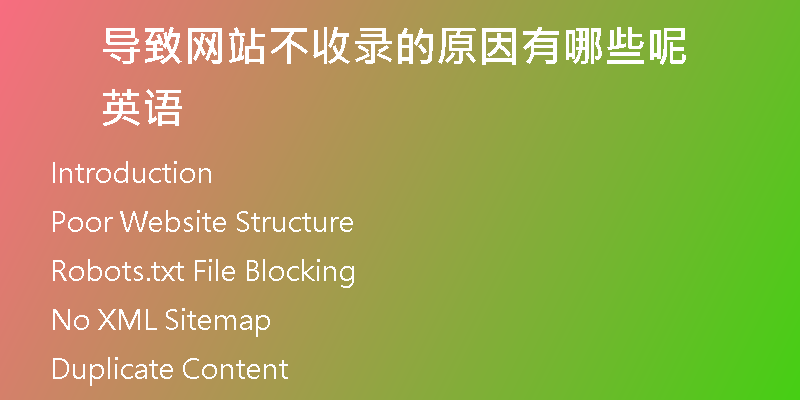
Poor Website Structure
The structure of your website can greatly affect its indexability. If your website is poorly structured, search engines might have a hard time crawling and indexing it. Make sure that your website has a clear hierarchy, with the most important pages easily accessible from the homepage. Use internal linking to help search engines navigate your website.
Robots.txt File Blocking
The robots.txt file is an important file that tells search engine crawlers which pages or sections of your website to crawl. If this file is not configured correctly, it could block search engine crawlers from indexing your website. Make sure that the robots.txt file is properly configured and allows search engine crawlers to access all important pages of your website.
No XML Sitemap
An XML sitemap is a file that lists all of the pages on your website. This file is used by search engines to discover and index pages that might not be easily accessible through links. If your website does not have an XML sitemap, search engines might not be able to index all of the pages on your website. Make sure that you create an XML sitemap and submit it to Google Search Console.
Duplicate Content
Duplicate content refers to content that appears on multiple pages of a website or on different websites. Search engines do not like duplicate content and might not index pages with duplicate content. Make sure that your website does not have any duplicate content. Use canonical tags to indicate the preferred URL for pages with similar content.
Thin Content
Thin content refers to pages on a website that have little or no content. Search engines prefer websites with high-quality content that provides value to users. If your website has a lot of pages with thin content, search engines might not index them. Make sure that all of the pages on your website have high-quality content that provides value to users.
Broken Links
Broken links are links on a website that lead to pages that do not exist or have been deleted. Search engine crawlers might encounter broken links while crawling your website, which could affect its indexability. Make sure that all of the links on your website are working properly and lead to pages that exist.
Poor Website Speed
Website speed is an important factor in SEO. If your website takes too long to load, search engines might not be able to crawl and index all of its pages. Make sure that your website is optimized for speed by compressing images, minifying code, and using a content delivery network (CDN).
Poor Mobile Optimization
Mobile optimization is becoming increasingly important in SEO. If your website is not properly optimized for mobile devices, search engines might not prioritize it in search results. Make sure that your website is responsive and works well on all types of devices.
Unnatural Links
Unnatural links refer to links that are created with the intention of manipulating search engine rankings. If your website has a lot of unnatural links, search engines might penalize it and not index its pages. Make sure that all of the links on your website are natural and relevant to the content on the page.
No Social Media Presence
Social media is becoming an increasingly important factor in SEO. Websites that have a strong social media presence tend to rank higher in search results. Make sure that your website has a presence on social media platforms like Facebook, Twitter, and LinkedIn.
Poor User Experience
User experience (UX) is an important factor in SEO. If your website has a poor UX, users might not stay on it for long, which could affect its indexability. Make sure that your website is user-friendly and provides a good experience for users.
Poor Content Quality
The quality of your website's content is important in SEO. If your content is poorly written, irrelevant, or unoriginal, search engines might not index your website. Make sure that your website has high-quality, relevant, and original content that provides value to users.
Black Hat SEO Techniques
Black hat SEO techniques are techniques that are used to manipulate search engine rankings in unethical ways. Examples of black hat SEO techniques include keyword stuffing, cloaking, and link schemes. If your website uses black hat SEO techniques, search engines might penalize it and not index its pages.
Technical Issues
Technical issues can also affect the indexability of your website. Examples of technical issues include server errors, DNS errors, and SSL certificate issues. Make sure that your website's technical infrastructure is sound and free of issues that might affect its indexability.
No Local SEO Strategy
If your website targets a specific geographic area, it's important to have a local SEO strategy. This includes optimizing your website for local search phrases and directories, creating a Google My Business page, and getting listed on local business directories. Without a local SEO strategy, your website might not appear in local search results.
No HTTPS Protocol
The HTTPS protocol is an important factor in SEO. Websites that use HTTPS are prioritized in search results over websites that use HTTP. Make sure that your website uses the HTTPS protocol to take advantage of this SEO benefit.
Poor Website Security
Website security is also an important factor in SEO. If your website is vulnerable to hacking or other security issues, search engines might not index its pages. Make sure that your website is secure by using strong passwords, updating software, and using security plugins.
No Schema Markup
Schema markup is a type of code that helps search engines understand the content on a website. If your website does not have schema markup, search engines might not be able to accurately index its pages. Use schema markup to help search engines understand the content and structure of your website.
No Local Citations
Local citations are mentions of your business name, address, and phone number on other websites. These citations are important for local SEO and can help improve the indexability of your website. Make sure that your business information is consistent across all local citations.
Conclusion
Ensuring that your website is properly indexed is crucial for SEO success. Consider these factors and make the necessary changes to improve the indexability of your website. Remember, a well-indexed website has a better chance of ranking higher in search results and attracting more traffic.